
 Contact & Support
Can’t find it? We can probably get it. Ask Us
The Circuit – February 2026 Newsletter
News From Our CEO
Where I’m Seeing Leverage Right Now
I left the PEI Executive Summit this year with a clearer sense of where the pressure is, and where the opportunity still lives.
Most leaders I spoke with expect to stay busy. Service demand is there. Investment is continuing. But nearly every conversation eventually landed in the same place: it’s getting harder to turn effort into margin. That challenge isn’t theoretical. It’s structural.
Labor Is the Cost Everyone Is Carrying
Labor dominated the PEI conversations, as it should. The companies doing the work, the ones dispatching technicians every day, are facing higher wages, tighter labor markets, and rising expectations from customers.
Most are already doing the right things: improving dispatch, tightening routes, simplifying workflows, and investing in training. Those efforts matter. But one reality came through clearly: even strong efficiency gains in labor only go so far.
You can work smarter and save time, but the financial impact of labor efficiency alone is often incremental. Important, but bounded. Here is where I think the industry is looking past a bigger lever:
Much of the service industry remains intensely focused on labor efficiency because labor feels controllable—and because parts are often viewed as a fixed cost tied to OEM pricing. If you believe the parts cost is immovable, then all the pressure naturally shifts to labor.
But that assumption isn’t always true. Aftermarket suppliers, whether through remanufactured products or high, quality new alternatives can create leverage that labor efficiency simply can’t. The impact isn’t incremental. It can be orders of magnitude larger on a single job.
The real challenge isn’t finding those savings. It’s recognizing them for what they are: margin opportunity, not just cost reduction.
Execution Still Runs Through People
Even so, margin is still won or lost in execution. This month’s employee spotlight is a good reminder that impact often comes from people who understand systems deeply and quietly make them better, whether that’s engineering, quality, supply chain, or customer support. Those improvements don’t always draw attention, but they compound over time and show up in reliability and consistency.
At PEI, many of the strongest service organizations described a similar focus: fewer systems, clearer ownership, and partners who help them execute rather than complicate the job.
Practical Value Beats Complexity
Technology and innovation were everywhere at the Summit, but the most grounded conversations weren’t about what was new, they were about what was useful.
- Does it lower total repair cost?
- Does it improve uptime?
- Does it simplify the job for the service company and the end customer?
That same mindset shows up in this month’s product spotlight: applying proven capabilities in new places with a focus on value, serviceability, and economics, not novelty.
Small Friction Still Matters
Not all leverage comes from big strategic moves. Some of it comes from removing everyday friction.
This month’s tech tip is a good example. Small operational nuisances rarely make headlines, but eliminating them saves time, reduces errors, and improves the customer experience. At PEI, those kinds of improvements were often described as quiet wins: modest individually, meaningful in aggregate.
What I’m Carrying Into 2026
The tone at the PEI Executive Summit was constructive and optimistic. The industry isn’t standing still. New opportunities are emerging and investment continues, but the bar has moved.
As I think about 2026, I’m less focused on how busy the industry is and more focused on where leverage is actually created, and whether organizations are willing to rethink long-held assumptions about where profit comes from.
Patrick Jeitler
Freedom Electronics President & CEO
Explore our journey and see what’s new on our eCommerce platform!
Product Spotlight
Freedom Enters Food Service in 2026
Interface Board
Part #: FR-5034031
Alto-Shaam Interface Board Assembly
Top Benefits
- Replaces FR-5034031
- Functionally tested for commercial reliability
- Supports Alto-Shaam control systems
- Compatible with select Alto-Shaam ovens, combi ovens, and warming cabinets

Freedom Quality
Better value and improved profitability for your repairs inside the store! Check out other Freedom Food Service items for Alto-Shaams on our website:
- FE-FA-36957 Axial Fan (230 VAC, 50/60 HZ) for Alto-Shaam Outright: $37 (over 50% off OEM)
- FE-SW39228 Power Disconnect Switch (60 A) for Alto-Shaam Outright: $105 (over 40% off OEM)
- FE-LI-37681R Kit, Alto-Shaam LED Panel Light Service Outright: $25 (over 40% off OEM)
Why Did We Make This Product?
- You use Quality Freedom remanufactured parts outside the C-Store—so why use expensive OEM parts inside the C-Store?
- OEM comparable pricing is over $700 more!
- Get credit for your cores!
- Remanufactured to OEM-level performance standards
Special Introductory Offer
Price: $595.00 exchange | Core Price: $345.00
Or call 866-676-6658 to place your order with our team.

Employee Spotlight

Chay Chauncey
VP of Sales
My Story: From Rural Field Tech to VP of Sales at Freedom Electronics
I began my career far from boardrooms or sales strategies—out in the field, driving back roads through small rural towns in Georgia with a toolkit in the passenger seat. I serviced IT equipment for local businesses that depended on those systems to keep their doors open. In those early years, I learned quickly that technology matters, but people matter more.
When a customer was down, it wasn’t just equipment failing—it was livelihoods on the line. My job wasn’t simply to repair hardware; it was to restore someone’s trust, ease their stress, and get them back to serving their own customers. Those face-to-face conversations, the late-night service calls, and the handshake moments taught me a lesson I’ve carried ever since: solve the customer’s problem and build a real relationship—everything else follows.
After moving to Atlanta to train field technicians and later becoming a solutions architect, I eventually led a global account worth over $500 million. No matter how big the role got, the core never changed: put the customer first.
That’s what I bring to Freedom Electronics. People ask why I chose Sales, and my answer is simple:
“I really enjoy working with partners to mutually solve business issues.”
I love the fuel dispenser industry as that same mindset is shared with all of our customers. I want to serve you with the same commitment I learned on day one. Let me know if we can help, my cell phone is 912-424-8943 call me anytime!!
Team Spotlight
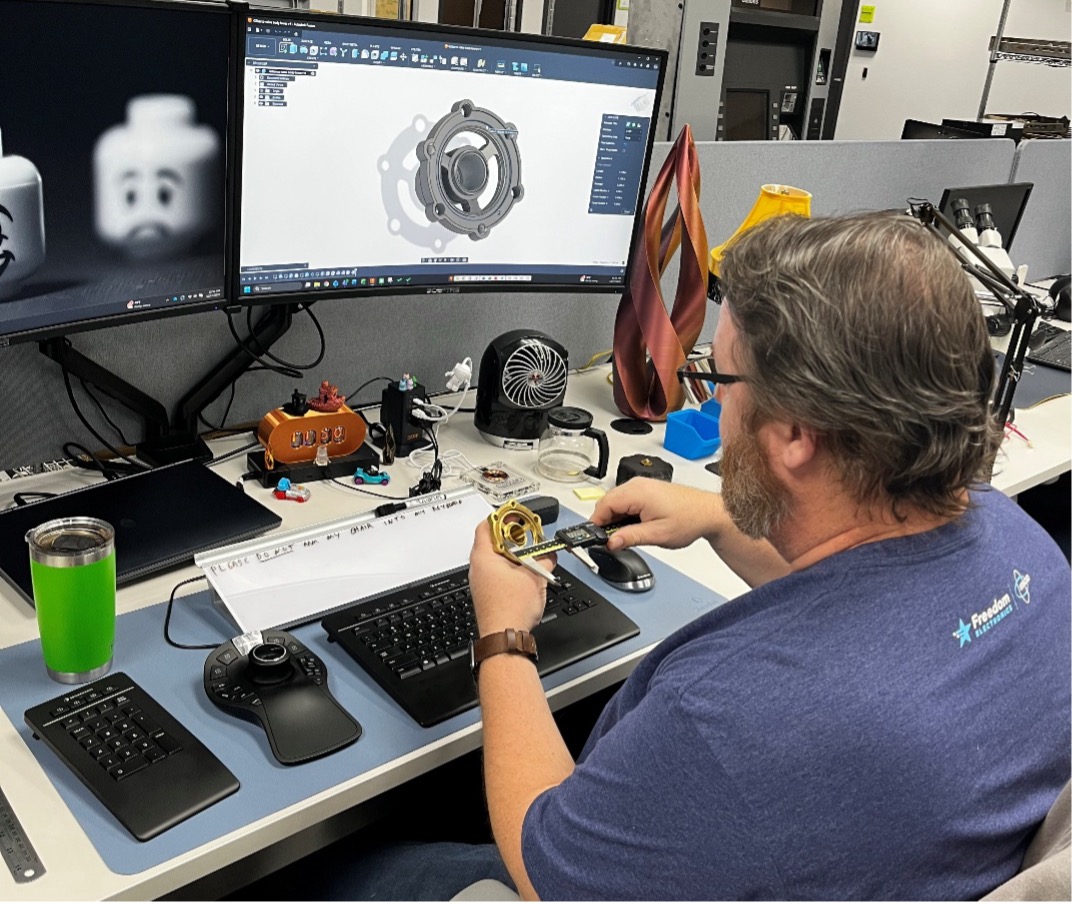
Engineering Department
Chris Payne
What I like most about working at Freedom Electronics is the challenges of being the only mechanical engineer and the ability to make a solid impact across multiple departments, not just within engineering. I joined Freedom in October of 2025.
Education: BS Mechanical Engineering Technology, Kennesaw State University
Previous experiences that have shaped my career:
- Avionics technician, Navy
- Field service technician, Reese Scientific.
- Electrical and Electronic Mechanic, Lockheed Martin.
Hobbies: BBQ competitions, building Lego.
Tech Tip: Penny Shortage Workaround
The U.S. Treasury plans to stop minting new pennies by early 2026 due to high costs and declining usefulness. Producing a penny now costs about 3.7 cents, resulting in significant financial losses, while cash usage has fallen sharply and many pennies sit unused outside active circulation. Although no new pennies will be made, the roughly 114 billion pennies already in circulation will remain legal tender and can still be used or deposited at banks.
As pennies become scarcer, some merchants are already experiencing shortages. However, Congress has not established any rules for rounding cash transactions, and there is no official Treasury guidance. Unlike countries such as Canada, the U.S. has not yet adopted rounding to the nearest nickel.
Many POS systems do not currently support automated rounding. As a result, transactions will continue to calculate exact totals. While cash payments may need to be rounded, digital payments—such as card-based or mobile app transactions—will continue to be processed to the exact cent.
In the meantime, PLUs used with departments and menu keys can be configured to allow cashiers to manually round cash transactions to the nearest nickel. Three rounding options are possible: always round up, always round down, or round to the nearest nickel, allowing each site to choose what works best for its customers. Refer to your POS manufacturer for details and assistance with programming and setup.
The rounding adjustment will clearly appear on the receipt. Department Sales reports will also show the total amount rounded up and down, helping managers reconcile sales with the cash collected.


Core Charge Refunds
Buy outright or exchange your cores for credit.

Top-Notch Support
We’re experts on fuel dispensers parts.

Secure Payments
All payment data is encrypted.
Join our mailing list
Receive our monthly newsletter and announcements
"*" indicates required fields